Non-invasive
No surgery, no needles, no probes. You sit on the chair. That is the whole procedure.

Laval · Sainte-Dorothée · pelvic floor health
You are not alone. About one in three women aged 40 and over lives with bladder leaks, whether after childbirth, at menopause or simply over the years. It often starts with the pelvic floor, the hammock of muscles that supports the bladder. And it is not something you just have to live with: there is a non-surgical treatment for urinary incontinence, right here in Laval.
Source: Canadian Urinary Bladder Survey (33% of women aged 40 and over).
The treatment, concretely
This is an intimate subject, and the fear of a complicated treatment holds many women back. Here is exactly what a session looks like, no surprises.
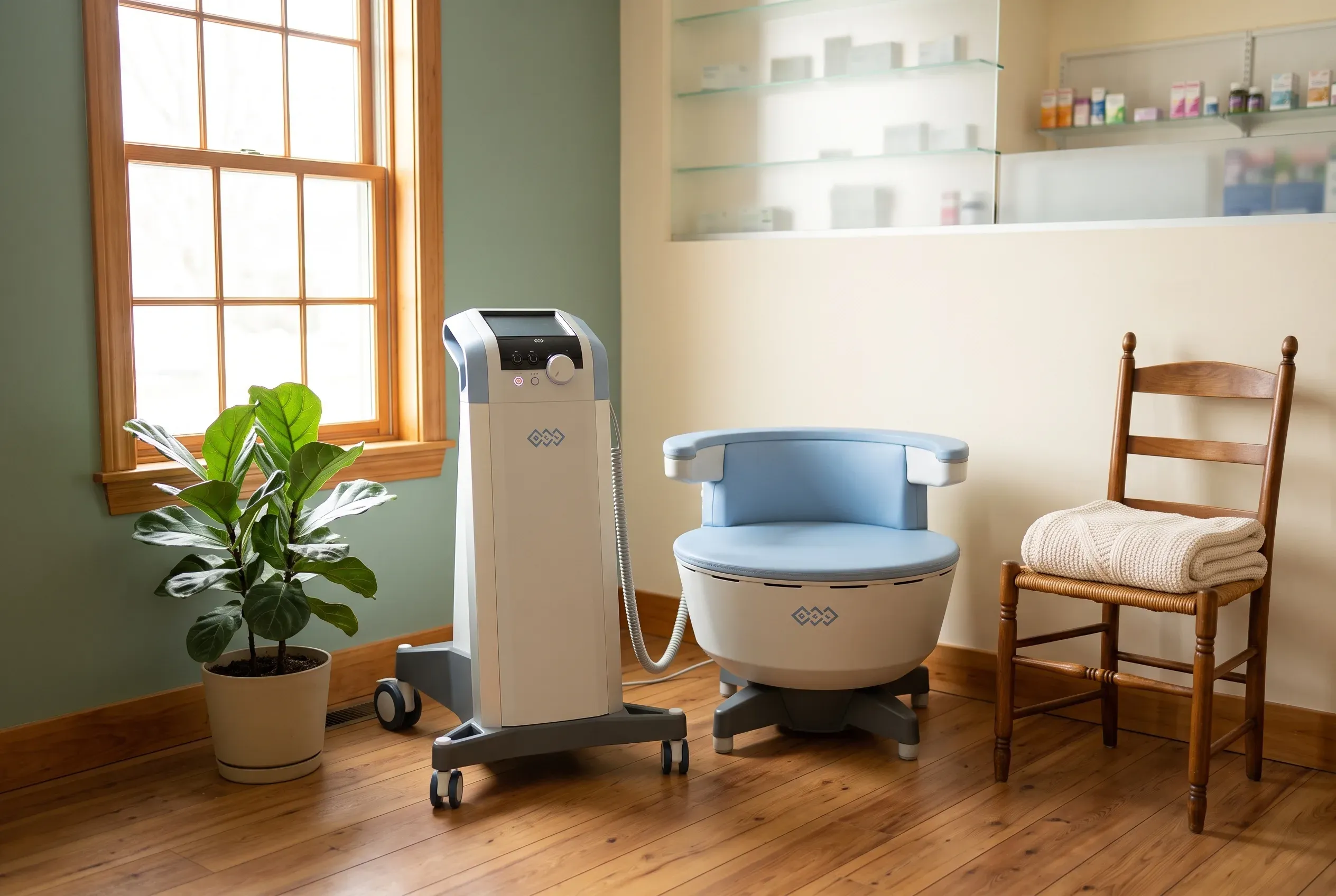
No surgery, no needles, no probes. You sit on the chair. That is the whole procedure.
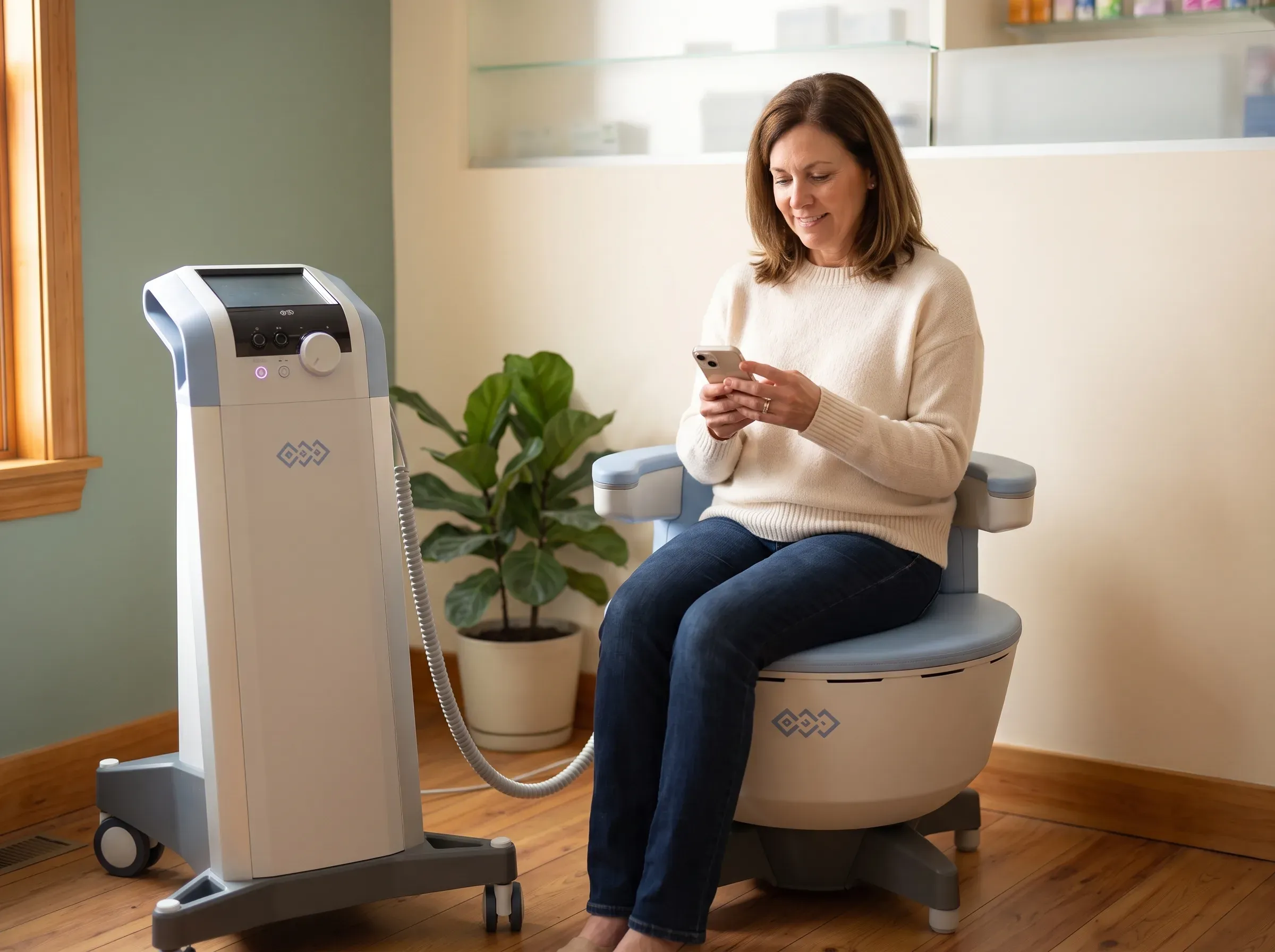
From start to finish. No undressing, no physical contact, no intimate exam.
About the length of a coffee break. Many patients use the time to read or simply breathe.
You leave right after and get on with your day. No recovery period, no time off work.
Why it works
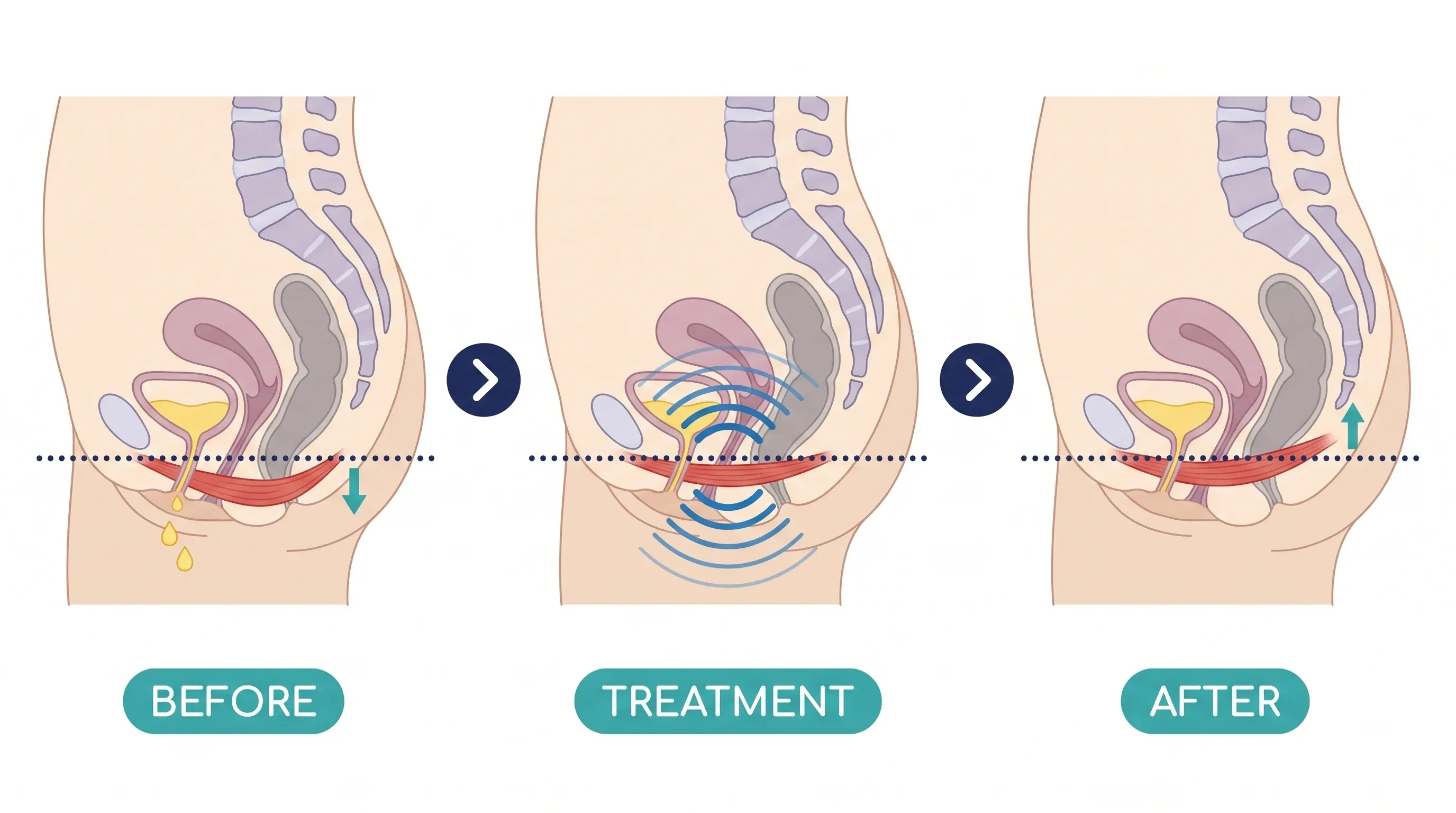
The Emsella chair uses high-intensity focused electromagnetic energy (HIFEM) to work the pelvic floor muscles deeply, at an intensity no voluntary exercise can reach.
That is the whole idea of pelvic floor strengthening: a toned pelvic floor supports the bladder better, which helps reduce everyday bladder leaks. No effort on your part, and no surgery. Curious how it compares with the do-it-yourself version? See our guide to Kegel exercises.
Source: BTL, manufacturer data.
In a pilot study of 30 women (6 sessions), 95% reported an improvement in their quality of life, and about two in three reduced or stopped using pads. A small, manufacturer-funded study — we tell you that plainly.
Published by BTL INTERNATIONAL.
Is this you?
A leak when you laugh, cough, sneeze, run or lift your grandchildren? That is stress incontinence, the most common form and the one that responds best to pelvic floor strengthening.
Urges that come out of nowhere and are hard to hold back, dictating your errands and outings? That is often a sign of an overactive bladder. Urge incontinence can be worked on too; the partner pharmacy team assesses your situation in consultation.
Bladder leaks after childbirth are common, even years later. Pregnancy and delivery put enormous demands on the pelvic floor. Strengthening it can change your day-to-day life.
Hormonal changes weaken the tissues and muscles of the pelvis. Many women aged 45, 60 or 75 seek help for the first time. It is never too late to ask the question.
If you are unsure, that is exactly what the free consultation is for: an honest assessment of whether the treatment fits your situation. And gentlemen, you are not forgotten: men have a pelvic floor too. See our page on the male pelvic floor.
Menopause and hormones
Falling estrogen weakens pelvic tissues and can reduce pelvic floor tone. The result, for many women around fifty: leaks that appear or get worse, more pressing urges, waking at night to urinate, sometimes a feeling of heaviness in the lower belly.
The pelvic floor, though, is still a muscle. And muscles can be strengthened at any age: through well-executed Kegel exercises, through pelvic floor physiotherapy, or through assisted strengthening like Emsella. If heaviness is your main symptom, read our page on pelvic organ prolapse first: it explains frankly what strengthening can and cannot do.
Talk to your doctor or pharmacist first; the free consultation then helps assess whether pelvic floor strengthening has a place for you.
Full transparency
The BTL Emsella chair and its HIFEM technology are licensed by Health Canada for the treatment of urinary incontinence, in both women and men (licence No. 98406, Class II medical device, first issued in 2017). This is neither a gadget nor a miracle promise: it is a regulated medical device, used in clinics across the country.
No treatment guarantees results. The whole point of the assessment is to determine whether this one is right for you.
The treatment is not for everyone. It is not recommended during pregnancy or breastfeeding, with metal implants in the pelvic area, a copper IUD, a cardiac pacemaker or defibrillator, or an implanted neurostimulator.
The partner pharmacy team goes through all of this with you during a free consultation, honestly and with no obligation, before any first session.
Where to start
A discreet call to the partner pharmacy. Ask anything: the team talks about this every week, without awkwardness.
A free, confidential meeting at the pharmacy: your situation, the contraindications, your questions.
You leave with a straight answer, then decide, with zero pressure, whether to start.
Your questions
No. You sit on the chair, fully clothed, and feel tingling followed by strong contractions of the pelvic floor: an unusual sensation, but not a painful one. Many patients use the time to read or listen to music.
A session lasts 28 minutes. You stay fully clothed from start to finish and go right back to your day afterwards: no recovery time, no time off work.
A typical course is 6 sessions, most often at one session per week. The exact schedule is set with you by the partner pharmacy team during the free consultation, based on your situation.
No, never. That is one of the big differences with this approach: you stay completely clothed for the entire session. No physical contact, no probe, no intimate exam.
Everyone is different. Some patients notice an improvement after a few sessions; for others, the effects build gradually over the course. No result can be guaranteed, and that is exactly what the pharmacy team assesses honestly with you during the free consultation.
The assessment consultation is free, with no obligation. If the treatment is a fit, expect around $300 per session; a full course is usually 6 sessions. The pharmacy team walks you through everything clearly, without pressure, before you start. A receipt can be provided; the expense may qualify as a medical expense for tax purposes, and some private insurers reimburse part of the cost — check with your insurer.
Yes, a few: pregnancy or breastfeeding, metal implants in the pelvic area, copper IUDs, cardiac pacemakers and defibrillators, and implanted neurostimulators, among others. That is exactly what the pharmacy team checks with you during the free consultation, before any first session.
The ones the manufacturer reports are rare and generally benign: temporary tingling or numbness in the pelvic area, a sensation of warmth in the perineum, gentle skin irritation if there was friction, and sometimes a more frequent urge to urinate for 24 to 48 hours. No downtime: you go right back to your activities. Our article "After Your Emsella Session" covers the first-24-hours guidelines.
No, it is not "too late". Many women live with bladder leaks for years thinking it is normal or irreversible. Strengthening the pelvic floor can be relevant at any age. The free consultation exists precisely to assess whether this treatment suits your situation.
Explore
Simple, jargon-free guides written to answer the questions the partner pharmacy team hears at the counter every week, from Kegel exercises to overactive bladder to prolapse.
Finding the right pelvic floor muscles, the step-by-step technique, the common mistakes, and what to do when Kegels are not enough.
Read the guide →Frequent, sudden urges to urinate: what is going on, the habits that actually help, and when to see a professional.
Read the guide →Nocturia has many causes, and not all of them start in the bladder. A straight answer on what helps and when to get checked.
Read the guide →Bladder leaks and a weakened pelvic floor after baby: when to start rehab and how to recover, even years later.
Read the guide →Leaks after prostate surgery, Kegel exercises for men, intimacy: men have a pelvic floor too.
Read the guide →Heaviness, a feeling of a bulge: what prolapse really means, and the honest (but real) role of pelvic floor strengthening.
Read the guide →Here in Laval
The treatment is offered at this site's partner pharmacy, Pharmacie Uniprix Samson, a neighbourhood pharmacy owned by its pharmacists in the heart of Sainte-Dorothée, minutes from Chomedey, Fabreville, Laval-Ouest.
You have probably already been there to pick up a prescription. Same place, same team, same discretion.

Everything about the partner pharmacy's Emsella service: uniprixsamson.ca/fr/services/emsella
1, boulevard Samson
Sainte-Dorothée, Laval (QC) H7X 3S5